Wednesday, 16 July 2014

Ringo and Charlie - an appreciation


Photo: Rob Shanahan

A recent post in the social media reminded me of this article from long ago…

Let’s talk drums. The revolutionary new floating action parallel snare strainer and internal damper will impress even the most (continued on page 386....)
Let’s talk drums. Consider first that nearly all of the great rock’n’roll groups switched drummers on the eve of their success. The Beatles, The Rolling Stones, The Who and The Clash all traded up (or down, depending on your point of view), thus depriving Pete Best, Tony Chapman, Doug Sandom and Terry Chimes of the joy of not having to touch their drum kits until show time. There are a few successful drummers, such as Fairport Convention’s Dave Mattacks, who perversely insist on unpacking and setting up their own hardware, but such cases are rare and psychologists are baffled.


Drummers come in for a lot of stick. How many times have you read about ‘the world’s only intelligent drummer’, or heard the cruel jokes about drummers hanging around with musicians? In every biography, sleeve note or fan club newsletter the drummer’s name usually comes last in the group line-up, but it is often the drummer (technically adept or otherwise), who is the driving force, the leader, the motivator.
Dave Clark, Mick Fleetwood, Phil Collins and Don Henley have all contributed much more to the success of their respective groups than the sound of a swishing hi-hat. Without wishing to get too Chris Welchian about it, a strong drummer is crucial.
Then there are the super drummers whose nuances, names and noses have been the down payment on world domination; Ringo Starr and Charlie Watts are two such men. Ginger Baker is a third, but he doesn’t have a new record out right now.
During Beatlemania, everybody in the world (bar the odd High Court judge) had heard of Ringo. His very name was the sole excuse for dozens of Jak and Giles cartoons. He had four rings on each hand! He was the shortest Beatle! He was the most famous drummer in the world and therefore much better than Buddy Rich or Eric Delaney.
Ringo’s style was simple. With the minimum of fills, he would maintain a steady four-to-the-bar on his bass drum whilst simply bashing away at the top kit, hi-hat ajar, head swinging from side to side. Critics would lambaste the fourth Beatle but they overlooked the simple fact that he could swing like Battersea Funfair.
Not quite so famous, but just as influential, was the great Charlie Watts; he of the granite boat race and orthodox grip (note 1). He had played jazz! He had worked in an advertising agency! Consequently, his image was more Jermyn Street than Charing Cross Road and his technique was a bit more tricky than Ringo’s, but only just.

Where are they now? Well, Ringo Starr fronts a supergroup (the All Starrs) with his able son, Zak, on drums and former members of The Nazz, The James Gang, Love Sculpture, Poco, Grin and The Guess Who, on all other instruments. These musicians provide faultless backing for some of Ringo’s Beatles hits, plus they get their own cameo spots, the best of which are Todd Rundgren’s ‘Black Maria’ and Burton Cummings’s ‘American Woman’. The worst is undoubtedly Joe Walsh’s excruciatingly crap version of ‘Desperado’, a curious (and spurious) choice.
The All Starrs’ live LP was recorded on 13th June, 1992 at the Montreaux Jazz Festival, presumably in front of learned students of the orthodox grip, who were probably far too busy rolling up their jacket sleeves to have ever been aware of Ringo hits such as ‘I’m The Greatest’. Therefore the audience reaction is, appropriately for jazzers, muted.
A week later, your correspondent witnessed this grand scale rock’n’roll cabaret at Radio City Music Hall and the cheer-led-at-birth Americans went wild as Ringo bounced around the stage, alternating McCartneyesque and Churchillian hand signals between the hits.
Charlie Watts, at the time of writing, leads his jazz combo and lends his famous name to Warm And Tender, an album of good, old-fashioned songs, sung by Nat Cole-oid native New Yorker Bernard Fowler. Beautiful melodies such as ‘Bewitched, Bothered and Bewildered’ and ‘They Didn’t Believe Me’ (‘when I tell them and I'm certainly gonna tell them...’ - that one) litter this collection. Throughout, Charlie tickles his modest kit, delicately brushing his snare drum and extra loud ‘sizzle cymbal’ (note 2).

Nowadays, there are drummers who, on their group’s stage plan, specify the area required to set up in cubic metres! In a pub! There are no photographs of Ringo or Charlie sitting behind massive arrays of redundant tom-toms. As any observer of tub-thumpery knows, four drums and four cymbals is quite enough kit to make a racket, and neither Ringo nor Charlie ever over-equipped. (OK, Ringo added a third tom-tom in 1968, but did he actually hit it?)
More importantly, there is not one Beatles or Rolling Stones recording that contains a complex or technically challenging drum fill. The records that Ringo and Charlie once had the privilege of playing on contained songs so great that any clever-dickery was superfluous. They made it all sound so easy and, as a result, thousands of young hopefuls fooled themselves into imagining that they could drum with equal effect. Most of us were wrong.
‘Will Birch is a drummer who has been hanging around with musicians for 29 50 years.’
1.      Orthodox grip versus matched grip - the great debate in The Ludwig Drummer circa 1964. Two different ways of holding the left stick (or right stick, if left-handed). The former, more of a ‘knitting needle’ approach, is the conventional style of marching bands, jazz drummers and Brian Bennett, whereas the latter, a more moronic method, was adopted by Ringo and therefore, most rock drummers. Charlie still adopts orthodox grip.
2.     A sizzle cymbal is concentrically drilled and then plugged with loose rivets that ‘sizzle’ when struck. Essential.
Originally published in Mojo 1993


Friday, 27 June 2014

The 45s: new Colts on the block


The 45s

The 45s (from Carlisle, England), are superficially indistinguishable from The Strypes (from Cavan, Ireland); each band features four mid-teen mop-tops in Mod togs, with extraordinary musical ability for their age, and a repertoire of fast, old school R&B. The Strypes appear to be having it off internationally, with US dates and a feature in Rolling Stone, due in part to management muscle, but The 45s also benefit from some professionally astute, caring guardians and should soon break out.

Military clobber, unseen for decades

But ‘it’s not a competition’. Or is it? Since the dawn of rock, the media has pitched one set of fans against another. 50 years ago it was Beatles v Stones. 10 years later, there was the Sweet/Slade divide. The Sex Pistols and the Clash could have ignited a bloody war if either side had realised their true potential. Then, in the 1980s, we had the Duran Duran/Spandau Ballet debate (ooh, get you). And for all we know, similar fan feuds occurred in the nineties and the noughties.


The 45s are 'Wilko Johnson's favourite band'. click this link: Wilko Johnson likes The 45s

But what every aspiring band really needs, if it is to realise its dreams - and this was fundamentally understood by Andrew Loog Oldham; Tony Secunda; Chas Chandler; Jake Riviera, Malcolm MacLaren; Bernie Rhodes; Simon Napier-Bell, and possibly Gareth (Stone Roses) Evans – is a SCENE, as in a whole one going. And there just might be a scene building for The 45s.

Click this link to see The 45s' It Ain't Over

Anyway, The 45s were off the road recently, apparently ‘revising for their school exams’. But whether or not they'll get the grades, they’ve certainly done their homework. Clearly raised on records, they have absorbed the sounds of their mums’ and dads’ (or possibly grandparents’) vinyl collections, which are rooted in 1960s white boy blues and mid-seventies pub pop power punk, with strains of the Small Faces, Dr Feelgood, The Jam and the stars of Stiff coming through. The Strypes cover Nick Lowe’s ‘Heart of the City’ and The 45s ‘kill’ the Hot Rods’ ‘Teenage Depression’. Both bands deliver incendiary versions of Jesse Hill’s ‘Ooh Pooh Pa Doo.’

45s / Strypes summit, photo courtesy of Dean Kennedy

There are a million teenagers out there who’ve never heard or seen this stuff, but it’s tempting to imagine they are the new young audience, just about ready to rock.

Click this link to see The 45s perform Teenage Depression


Friday, 30 May 2014

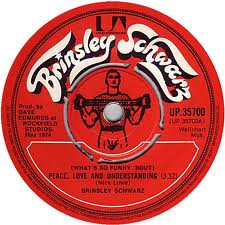
40 years of Peace, Love, and Understanding


As this majestic song enters its fifth decade, some of us will recall those barroom comedians who couldn't resist uttering 'Yeah, peace and love, man', as one of our longer-haired brethren shuffled past. It was the predictable dig from hippie-bashers, post-Woodstock, as they taunted anyone in an ex-army greatcoat and loon pants - as later portrayed by Nigel Planer's 'Neil' in The Young Ones. But what on earth was wrong with peace and love? Are they not the universal goals of civilisation? The 'joke' became tiresome and was possibly what was on Nick Lowe's mind when, in 1974, he sat down to pen a new take on the dull cliche.

Lowe has since described composing the song as 'the seismic moment' of his early songwriting career. Title-wise, he may have been subconsciously influenced by The Gaylads' 1970 ska classic 'Peace Love And Understanding' as it boomed out from a North London jukebox around the time his group was packing 'em in on the London pub circuit. Tune-wise, Lowe acknowledges the influence of Judy Sill and her 'ginchy little lick' in 'Jesus Was A Cross Maker'.

When the song opened The New Favourites of Brinsley Schwarz in 1974, '(What’s So Funny 'bout) Peace, Love And Understanding' sounded fabulous and modern, with its power chords appropriated from The Who and a lyric that at first seemed tongue-in-cheek, cynical even, but one that has gained in poignancy in today’s even more ‘troubled times’.


‘The Brinsleys’ had troubles of their own, still scarred from the 'The Fillmore Hype' of 1970, in which a planeload of journalists were flown to New York to witness the group’s hesitant debut. Although they established themselves as kings of the London pub rock scene, they had become trapped. It was thought that recording with ace producer Dave Edmunds would yield some hits, but within a year the group had disbanded, sick of communal living and one too many trips up the motorway to play Scarborough Penthouse Club yet again.

But ‘Peace, Love and Understanding’ would have a life of its own. In 1978 it was recorded by early Brinsleys fan Elvis Costello, and released on the US version of his Armed Forces LP. Then, in 1992 the song was covered by American musician Curtis Stigers for the soundtrack album to the hit movie The Bodyguard. It is said that leading actor Kevin Costner, himself a rock music fan, insisted on its inclusion. It became the biggest selling soundtrack recording of all time, clocking up sales in the tens of millions. Consequently it earned Lowe considerable royalties, allowing him to work at a more elegant pace, but also enjoy artistic control of his subsequent music and retain his trusty road band. The song is still a permanent fixture in Lowe’s live shows. Sung at a slow tempo to acoustic guitar accompaniment, it has acquired an almost hymn-like quality and his attentive audiences listen in reverence.


Nick Lowe recalls the song’s genesis: “I think I’d originally thought of it as being funny, because the old hippie thing, which I’d invested a lot of my time and energy into, had become a load of old bollocks. I had that poetic thing… ‘As I walk this wicked world, searching for light…’   I was doing it tongue in cheek, using those words, thinking about some hippie saying, ‘It might be all changing now but when it comes down to it, you might laugh, what is so funny about…’ I thought it was a fantastic title, I couldn’t believe my luck. As long as that title popped up now and again it didn’t really matter what I sang about in between… of course I thought peace and love were basically good, but suddenly the old dream was over and I was in the right place at the right time, front and centre, to come up with something like that.  It was a sort of waking up song.”

(What’s So Funny ‘bout) Peace, Love And Understanding
Recorded by Brinsley Schwarz at Rockfield Studios, 1974
Produced by Dave Edmunds

Hear a sample and download MP3 here: http://tinyurl.com/69el564

With thanks to Pete Silverton, who clued me up on The Gaylads


Friday, 4 April 2014

Lee Brilleaux 10 May 1952 - 7 April 1994


Photo: Patrick Higgins

To commemorate the 20th anniversary of Lee's death I offer the following article written for Uncut in 2004.

An Officer and a Gentleman

As the media trumpet the genius of Kurt Cobain, who shot himself in the head 10 years ago, let us not forget another rock’n’roll hero who died that same week, gentleman Lee Brilleaux. When news of Cobain’s messy demise reached the UK, news editors were tasked with shuffling the obituaries, with Cobain ‘enjoying’ the edge. But although Cobain’s music owed little to the barroom R&B of Dr Feelgood, the Nirvana phenomenon was arguably a knock-on effect of the Sex Pistols, whose own licence to thrill was enabled by the Feelgoods. So, in a sense: no Brilleaux, no Cobain.

For over 20 years Lee fronted a succession of Feelgood line-ups, dispensing white-hot R&B from stages large and small. He gave it the max every night and like all great performers, the tougher the job, the harder he worked. In the group’s early days, Lee stunned tiny pub audiences with wild antics and a back-to-basics musical approach, incongruous with the hyperbole of progressive rock, then in its heyday. When the Feelgoods made their London debut in 1973, it was frankly touch and go, but the group quickly adapted to the demands of the circuit, building a huge following and smashing attendance records in pubs and clubs.

Lee and guitarist Wilko Johnson had no problem making the transition to larger stages; they simply exaggerated the moves they had honed in the pubs. Wilko recalled, “We got four gigs supporting Hawkwind. We were completely unknown and in Manchester they threw pennies at us. I remember Lee calmly picked up one of the pennies. Then he bit it, and with a mean look, tossed it aside, as if it were a dud. The place erupted. It was a turning point.”

It was the combination of Lee’s cool nonchalance, Wilko’s maniacal careering back and forth and the fastest, most relentless music on the scene that made the Feelgoods a top concert attraction. And when the group enjoyed something of a revival in the late eighties, Lee looked like a giant from the furthest corner of the cavernous Town & Country Club as he took the stage in a powder blue suit, belting out ‘King For A Day’.

Space considerations do not permit a re-telling of the Feelgood legend. Those Uncut readers who saw the group at their mid-Seventies peak know what all the fuss was about whilst younger readers will soon be able to check out the Feelgoods’ Going Back Home concert from 1975 on DVD. 

Lee’s widow, Shirley, who first met Lee in the mid-seventies, recalls, “He was very methodical and lived his life by the rules. In his mind, it was OK if an old dear jumped the queue, but God help anyone else. He was incredibly moral and his integrity was impeccable. One day our daughter, Kelly, came home from school with a £10 note she had ‘found’. Lee marched her down to the school and made her tell the headmistress how she’d come by the money. I’d like to think it made a lasting impression on Kelly.” 

“He was very loyal,” says Larry Wallis. “If anyone started to bad-mouth someone to him, Lee would say, ‘You’re talking to the wrong man.’ Today, if I find myself with a moral dilemma, I always ask myself, ‘What would Brilleaux do?’ ”

“Lee was also very intense,” continues Shirley, “and not the easiest person to live with. The fact that we were together for 18 years is largely attributable to the fact that he was away so much, because he expended a lot of that aggression on tour.”

In 1991, Lee sat for local artist Anthony Farrell and over the next two-and-a-half years attended some 30 sittings, resulting in two paintings, the second of which was completed during the final months of Lee’s life. Deemed too harrowing for public display, it shows Lee in the final ravages of non-Hodgkins lymphoma, weak from chemotherapy and near to death. “After I finished the first picture he told me he wasn’t well,” says Anthony, “but he agreed to a second one. It evolved as the drama unfolded. It was appallingly difficult, seeing someone deteriorate in front of my eyes. I could have chickened out at any point but Lee was as tough as nails. He knew the game was up, but he put a brave face on things.”

In the summer of 1993, Lee came out of hospital and took his family on holiday to Disneyworld, a very un-Brilleaux like destination it would seem, but there is evidence of Lee enjoying Big Thunder Mountain Railroad, holding onto his silver-topped cane. Of course the trip to Florida was for his children, Kelly and Nick, of whose progress he would have been extremely proud. Nick, now 16, has a promising future as a film-maker, evidenced by his hilarious website at brilleauxfilms.com

Lee’s final public appearance, in January 1994, was at the Dr Feelgood Music Bar on Canvey Island. Extremely frail, but with a glint in his eye and immaculately attired, he perched on a stool centre stage and heroically performed a mix of Feelgood classics like ‘Down At The Doctors’ and newer material from his final recording, The Feelgood Factor.

Then, on 7 April 1994, he died, a victim of cancer at the age of 41. At Lee’s funeral, his best friend and business manager, Chris Fenwick, gave a moving eulogy before Lee’s coffin was despatched to the sound of Junior Walker’s ‘Roadrunner’, a Brilleaux favourite. An enduring memory from that day was the sight of Dr Feelgood’s three surviving original members - Wilko, Sparko and the Big Figure - huddled together in the graveyard, mourning the loss of their former singer. Wilko, in particular, was in a highly emotional state. He had not seen much of Lee during the 17 years that separated his own dramatic exit from the group and Lee’s death.

Neither of them lived on Canvey any longer, in fact when the Feelgoods became successful they both left for the mainland, Lee to a smart house in Leigh-on-Sea, that he named ‘The Proceeds’, and Wilko to an equally imposing residence a mile or two away in Westcliff.

“I don’t think Lee ever spoke to Wilko,” says Shirley, “but he spoke a lot about him.” Their paths never crossed, until the fateful day in 1991 when a Japanese promoter thought it might be a terrific wheeze to put them on the same bill.

I recall the night Chris broke the news to Lee over a curry. “We’ve been offered some dates in Japan,” Chris announced warily. “Great!” said Lee, slurping a lager, “good money?” “Yeah, the money’s OK,” replied Chris, “but there might be a snag – we’re opening for Wilko.” All eyes turned to Brilleaux, half expecting him to choke on his madras, but of course Lee responded calmly, taking the opportunity to have a good-humoured dig at the guitarist. “I see,” said Lee, “and might we be travelling on the same plane?” “I’m afraid so,” replied Chris. “Well then, I’ll upgrade to first class so that when Wilko gets on the plane, I’ll be sitting up front, getting stuck into the champagne. And halfway through the flight, I could turn around and raise a glass to Wilko.” Lee then paused thoughtfully, remembering Wilko’s teetotalism, and added, “Oh, sorry Wilko, you don’t, do you?” 

Brilleaux’s local pub was The Grand, after which he named the independent record label that handled the Feelgoods reissues. “It was his second home,” says Shirley, “in fact sometimes, when he returned home from a tour, he would go there first.” The Grand was a five-minute walk from The Proceeds and over a period of about 10 years, in between tours, it was where Lee could be found most evenings around six, enjoying ‘an early one’. He would sit at the bar, peering over half-moon specs, toying with the Telegraph crossword, whilst awaiting the arrival of his small coterie of drinking buddies, to whom he gave amusing names, such as ‘Dennis The Dog’, ‘Ron the Kite‘ and ‘Colin the Socialist’.

Lee tolerated The Grand, even when it was a poorly managed house, but he really lost his temper the night the pub ran out of ice, giving him an opportunity to exercise his cool style. They still talk about the night Lee sidled up to the bar and ordered a gin and tonic, only to be told, “Sorry, there’s no ice.” Lee calmly went to the payphone and ordered a taxi. Twenty minutes later he returned from the supermarket, slapped a large bag on the bar, and roared, “There’s your fucking ice, now give me a gin and tonic!”

Lee’s drinking was legendary and it is impossible to overlook this aspect of his character. Once or twice, I found myself on the road with the latter day Feelgoods, manning the ‘merch stall’ for Chris. At the Douglas Lido, five minutes before curtain up, I watched in disbelief as he prepared his on-stage refreshment. He lined up three pint glasses, each filled with ice, into which he decanted an entire bottle of Gordon’s gin. The industrial strength cocktails were then diluted with an inch or two of tonic - no more - and ceremoniously placed on the drum riser. They lasted Lee until midway through the set, by which time a gaggle of bikers had gathered in front of the stage, and were menacingly shaking up cans of lager. During ‘Rock Me Baby’, I think, the cans were cracked open and Lee was sprayed with beer. Ever the showman, his reaction was to simply smile, roll back his head and bask in the foaming shower, holding out his arms and gesturing for more.

“When he was working he was very careful not to cross the line with his drinking, although he did often make it across that line,” says his wife. “He was more apt to overdo it when he was at home. He loved going to restaurants, food and wine, books and music - that was how he wanted to live out his life. But he was also a wonderful father and husband. When I was training to become a nurse, he would be home, doing the shopping, cooking, picking up the kids, he did an awful lot. I keep finding old cookbooks with Lee’s notations and little recipes he invented. He used to write out the menu and post it on the door.”

Adds Larry Wallis: “When I talk about Lee, food features a lot. He was a trencherman. Not that he ate a lot; he just ate well. Pickles and chutneys were a big one with Lee - he didn’t buy ‘em, he made ‘em. At Christmas, there was always the appropriate time to take a stroll down to the pub and stop off at various shops to give Lee time to order the pork pies, the haunch of venison and the right casks of beer that had to be brought into the house so many days before the event. Brilleaux was the master at entertaining, he was the quintessential Englishman.”

“When they were on tour, he would always have his Michelin Guide or a book on objects of historic interest. He would know the chateau to visit and the three-star Michelin restaurant that was nearby. And he always knew the little village off the beaten track where you could find a local ale he hadn’t tried yet. If you mentioned, for example, Henry VIII, Lee would be able to tell you some completely obscure, but incredibly amusing fact about him.”

So extensive was Lee’s knowledge of European hotels and restaurants, built up through years of hard touring, he even considered writing a book, jokingly referred to as ‘The Brilleaux Guide’. In Europe, while other group members drove, he would travel by train or plane. He usually wore a suit, to improve his chance of an upgrade. “He was quite blunt about it,” says Shirley. “He didn’t have the time or the patience for arduous journeys in the later years.”

Kevin Morris, Dr Feelgood’s drummer since 1983, agrees that Lee’s travelling arrangements were partly a desire to experience as much as possible of what ‘the road’ had to offer. “Lee and I would often get up early and stop somewhere civilised for lunch, then relax before the evening’s show,” he recalls. “Lee knew all the best places and what local delicacies might be on offer. It made touring bearable.”

Lee was also a bit of a dandy and would always dress for the occasion, whether it be fronting the Feelgoods, or strolling out to a luncheon. Larry Wallis pictures the scene: “Sunday night at the Hackney Empire, five minutes to show time, and Lee’s preparing to become the on-stage spiv. The Slim-Jim strides are on, the box jacket is on its hanger ready for action, and the inch-wide necktie is nicely in place when Lee produces a fabulous pair of side-lace-up winkle-pickers about a yard long. I enquire of their origin. ‘They come from a little shop in Carnaby Street,’ says Lee, ‘that does an absolutely disgusting range of foot-furniture.’ I cracked up. The last time I saw Lee, he was wearing the tweed cheese-cutter, a Barbour jacket, silk cravat and a lovely pair of Sherlock-style boots, topped off with the walking stick. ‘Nice outfit Lee,’ I said. Lee looked puzzled for a moment. ‘What outfit?’ he asked.”

Lee was a hero and a gentleman and enjoyed a huge amount of admiration and loyalty from fans and friends alike. In his book, Down By The Jetty, Tony Moon wrote: “The image that Lee evoked as a frontman became, for us, a barometer against which anything and everything could be measured and tested. For example, if we were watching something on the telly, our immediate retort would be, ‘Yes, but would Lee Brilleaux like it?’ For example, would Lee Brilleaux like gatefold double album sleeves? Low-tar tipped cigarettes? That style of shirt? The answer always seemed to be a very positive and life-affirming, ‘NO HE FUCKIN’ WOULDN’T.’ ”

Nick Lowe, producer of two Dr Feelgood albums and co-writer of ‘Milk And Alcohol’, has the last word: “Even back in the seventies, I used to feel a bit thick around Lee. He was so well-read and rounded. The last time I saw him for lunch, we arranged to meet in the French House. He looked like a medieval English professor at some red brick university, swathed in tweeds and finishing The Times crossword, which he put away very hurriedly when I arrived. He was pretty focussed that day on things he wasn't focussed on before. He was always very elegant, but towards the end there was this great knowingness. Lee was a really classy guy. I think about him all the time.”


BRILLEAUX STYLE

Lee's consuming passions, from Howlin' Wolf to Soho boozers...
Howlin’ Wolf left Lee reeling when he performed live at the King’s Head, Romford in 1968. He paid a tribute to his hero on the final Feelgood recording, Wolfman Calling. 
Auberon Waugh’s column in the Daily Telegraph was a must-read, as well as Dickens, Trollope and Patricia Highsmith. The Crust On Its Uppers by Derek Raymond, Earthly Powers by Anthony Burgess and the travel books of Eric Newby were also on his list.
“Squire Haggard’s Journal by Michael Green was Lee’s favourite book,” recalls Larry Wallis. “I spent a Christmas at Lee’s house crying with laughter over it. I referred to Lee as Squire Haggard - very English, fond of a decent brandy.”
Los Caracoles, Barcelona was one of Lee’s favourite restaurants. Others include La Coupole, Paris, and Gay Hussar in London. “The wild man of R&B always carried the Michelin Guide,” says Wallis.
Mr Eddie & Chris Kerr of Berwick Street was Lee’s tailor, supplying the stage suits that withstood a nightly pounding.
Gent’s Suede Chukka Boots by New & Lingwood of Jermyn Street - Lee was extremely excited when he discovered these little numbers.
‘She Does It Right’ was Lee’s favourite Feelgood track. He acknowledged that Wilko’s songs were the essence of the early Feelgoods.
The Coach & Horses in Soho was one of Lee’s favourite pubs, not least of all because of its association with the writer Jeffrey Bernard. And The Punch House in Monmouth was “always worth a detour.” 
Courage Directors heads the beer list. “He enjoyed the Spanish brandy Cardinal Mendoza,” recalls friend Keith Smith. “If you were dining at The Proceeds you knew you were in for a very late night when Lee announced it was time for the Cardinal.”
Toby Jugs - the Feelgoods themselves were immortalised in glazed clay for 1979’s Let It Roll.

With thanks to Shirley Brilleaux, Larry Wallis, Kevin Morris, Chris Fenwick and Keith Smith.


Lee and Will 1986 Photo: Steve O'Connell

Two new Lee Brilleaux-related books are in the works:

Roadrunner: The authorised biography of Lee Brilleaux by Zoe Howe - Unbound Books - pledge here: 
http://unbound.co.uk/books/roadrunner

Shot of Rhythm & Blues - photographs by Patrick Higgins


Wednesday, 12 March 2014

Brinsley Schwarz and The Fillmore Trip

Billy - Bob - Brinsley - Nick (NYC 1970) 

The preposterous 1970 launch of the band Brinsley Schwarz – affectionately known to its participants as ‘The Hype’ - is the stuff of rock legend. To describe it in the briefest way possible, its movie logline might read: ‘Over ambitious pop managers launch incompetent beat group by sending a plane-load of drunken journalists to review their debut in New York… hilarity ensues.’


The Cadillac Allocation List
Of course, as we all know, Brinsley Schwarz returned from America with their tails between their legs. Shunned by the media and disillusioned by the outcome of their disastrous launch, they soon adopted a crucial anti-showbiz ethos that gave rise to the London Pub Rock Scene, from which… [cont on P248]


Fame Pushers Ltd previously Wornet Ltd
I wrote about it all in No Sleep Till Canvey Island – The Great Pub Rock Revolution (Virgin Books 2000, 2003) following many years of research, during which I interviewed most of those who took part and assembled the story in minute detail. I have recently been revisiting the text in preparation for a new book, so imagine my surprise when I turned on the radio today (BBC Radio London: The Roberts Elms Show) only to hear a chap named Russell Clark reciting the story, as it appears in No Sleep, more or less word for word! Although I missed the start of the broadcast, I am assured by Mr Elms that I did get a name check, for which I am grateful.

Airline dining 1970
Anyway, a listener to the show called in and said he thought the story would make a great film. Well… some years ago I was approached by a film production company in Hollywood who wanted to option the story for a proposed dramatisation. Lawyers were engaged and draft contracts were faxed back and forth, but nothing came of it. I remember telling Nick Lowe about the possibility of his portrayal in a dramatic reconstruction of ‘The Hype’, to which he replied: “Yeah! With Johnny Depp as Dave Robinson!’

Follow Will Birch on Twitter

Tuesday, 25 February 2014

Marshall Crenshaw: Still rising after all these years


A recent post in the social media reminded me of this article from long ago...

Here is a guy who's been picked to click so many times it's ceased to be funny. He's even been described, in this very organ [Mojo], as a future 'pop god'. For the uninitiated, and regrettably there must be millions of 'em, Marshall Crenshaw specialises in luxurious guitar pop with cunning melodies and sublime vocals, and he has stayed true to his ideal throughout the making of eight albums in twice as many years.

Crenshaw first got noticed playing the John role in Beatlemania on Broadway. Apparently, he clashed with 'Paul', but was saved from the How Do You Sleep syndrome when Warner Brothers signed him in 1981. His self-titled debut, which featured the wondrous Cynical Girl, was mainly a roots rocking affair. "I heard rock'n'roll around the house when I was a child," he recalls. "I would imagine it was my job to write the follow up to C'mon Everybody for Eddie Cochran and I hit on a formula with certain grooves. Like Some Day Some Way was similar to Party Doll by Buddy Knox."

For his follow-up, Field Day, Crenshaw chose British producer Steve Lillywhite.  "The record company was taken aback, but I wanted that big sound. I bought it and I paid for it." From then on, it was a different producer for every record; T-Bone Burnett for Downtown, which contained the magnificent Blues Is King and Ben Vaughn's immortal I'm Sorry (But So Is Brenda Lee); Don Dixon for Mary Jean & 9 Others, with its stand-out cut Calling Out For Love (At Crying Time). After 1989's disappointing Good Evening, it was a case of 'That’s All Folks' from the brothers Warner.

Looking back on his '80s records, Crenshaw has some misgivings. "It seems like the even-numbered albums are pleasant to recall, but the odd-numbered ones were excruciating. Let's see… first one - hard, second one - fun, third one - impossible, fourth one - fun, fifth one - ugh!" He's clearly uncomfortable with the way some of those records were made: "They were recorded in that piecemeal '80s way. I don't understand why that method evolved. Whose bright idea was it to remove the elements of immediacy and spontaneity from rock'n'roll? Who thought of that?" he demands. But this is the artist talking. The end results were nearly always impressive and the Crenshaw catalogue from this period is crying out for a CD retrospective.

In 1991 Crenshaw signed with Paradox Records and released Life's Too Short, another spectacular flop. Fortunately, a number of extracurricular activities kept the wolf from Marshall's porch, including film appearances (La Bamba, Peggy Sue Got Married) and the authorship of Hollywood Rock, a book celebrating rock'n'roll in the movies. Also, his songs get covered. "I suppose my biggest song is You're My Favourite Waste Of Time.  Bette Midler did it first, then Owen Paul hit big with it. It’s the gift that keeps on giving."

Crenshaw also co-wrote the Gin Blossoms hit Til I Hear It From You, for which he received a BMI award. More recently, Crenshaw has signed with Razor & Tie (Grapevine in the UK) and released Miracle of Science. "This is my third and last record company," he maintains. "I made the record at my home studio and in Nashville, in the most relaxed circumstances possible, either working alone or with long time friends that I trust."

At a recent Borderline show in London, Crenshaw performed an unplugged set for the faithful, but aside from a 50 city US jaunt to promote Miracle Of Science, he rarely tours. "I'm not a road dog. It used to be my bread and butter in the '80s, but it's not me anymore."

Today Crenshaw seems resigned to his fate: "My window of opportunity to be a star was in the early '80s when my first couple of records came out. I had a little shot for a minute, but I'm not going to be a pop star now, and I don't expect to be.  My stuff's out there if you want it."

Originally published in Mojo 1997